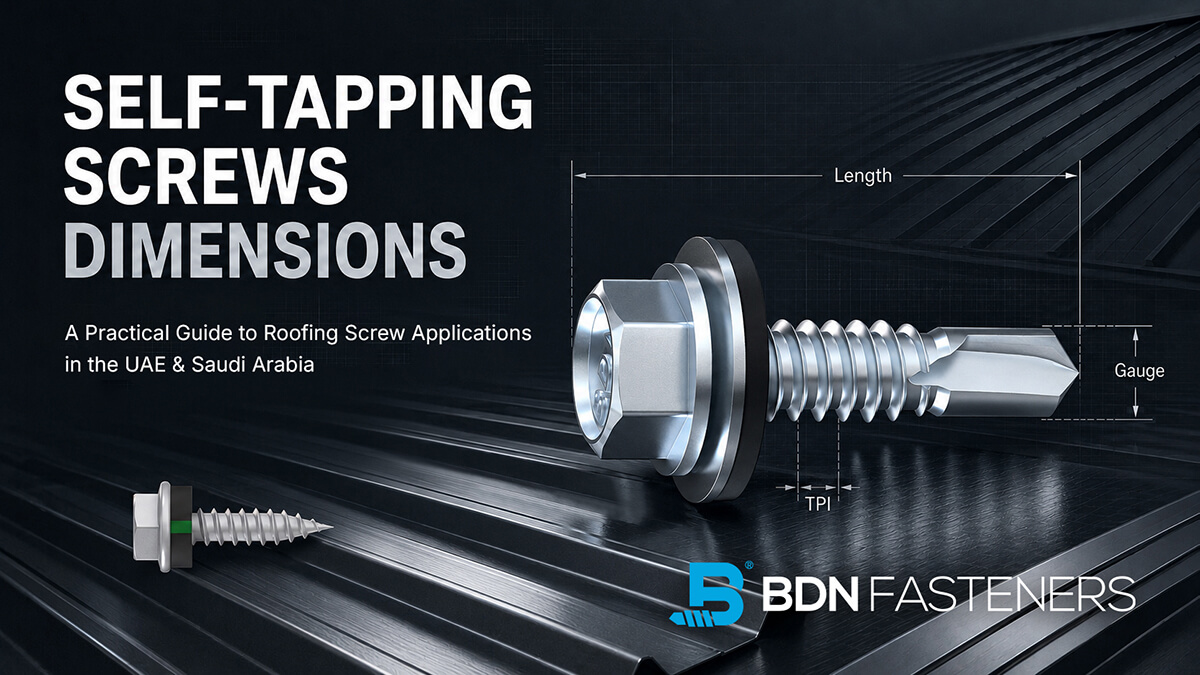
Self-Tapping Screw Sizes Chart: Complete Size Comparison table
A Professional Guide to Choosing the Right Screw Size
Why a Self-Tapping Screw Size Chart Matters
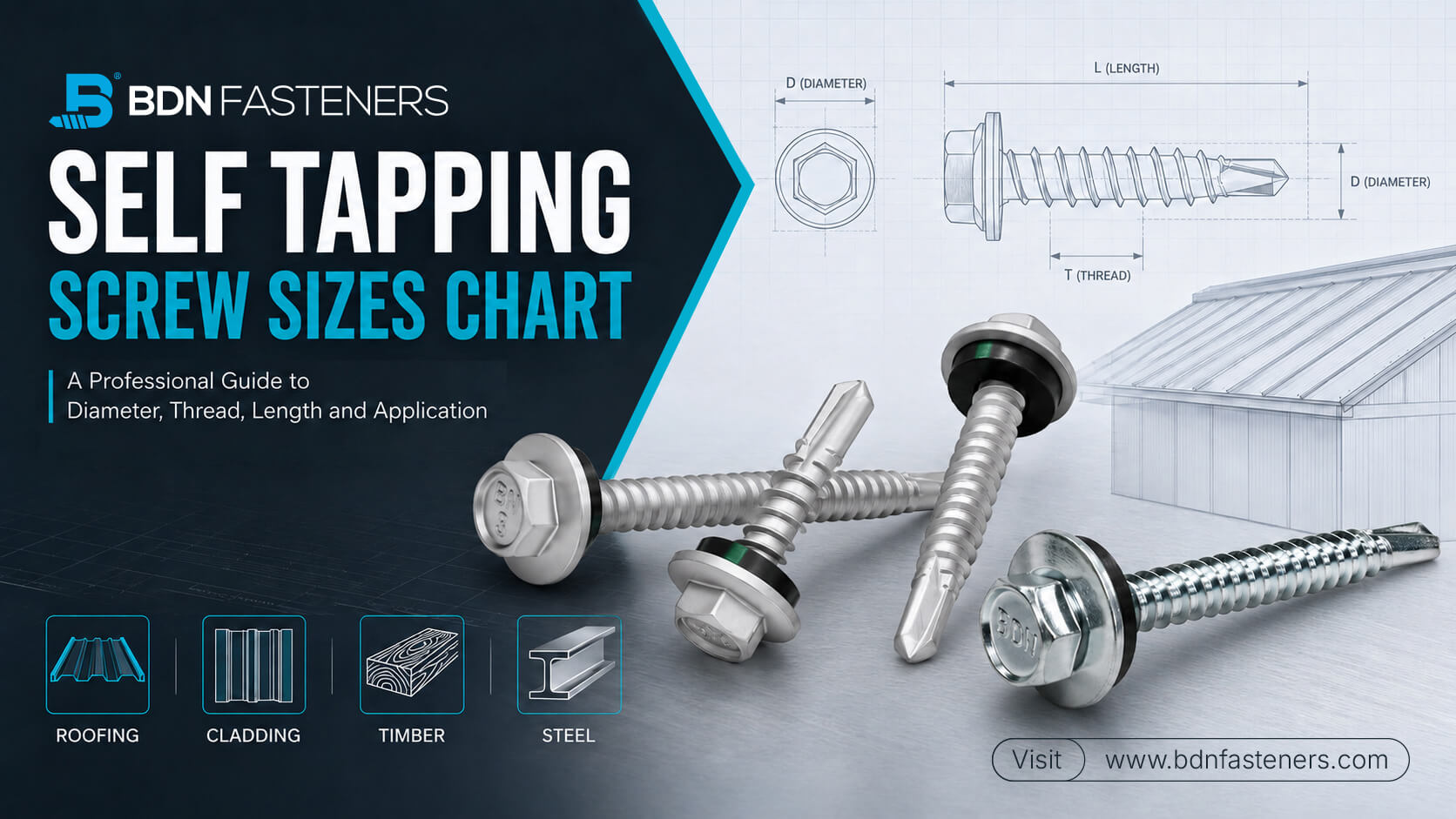
A self-tapping screw size chart is more than a list of numbers. For builders, roofing contractors, steel fabricators, cladding installers, and fastener wholesalers, it is a practical selection tool that helps match the screw to the substrate, panel thickness, fixing position, pull-out requirement, corrosion environment, and installation method.
Self-tapping screws are designed to create their own mating thread as they are driven into a material. In construction and roofing applications, the term is commonly used for screws that fasten steel sheet to timber, light metal, trusses, purlins, cladding panels, and other building substrates. Some self-tapping screws use a sharp Type 17 point for timber. Others use a blunt or reduced point for pre-punched steel, light gauge sheet, or specialty applications. Closely related self-drilling screws add a drill point that drills, taps, and fastens in one operation.
Because these screws perform several functions at once, size selection is critical. Choosing a screw that is too short may reduce holding strength. Choosing a screw that is too long may slow installation, increase cost, or create unnecessary protrusion. Choosing the wrong diameter, thread, point, or washer may affect pull-out strength, corrosion resistance, and long-term watertightness.
This guide explains how to read common self-tapping screw sizes such as 10-12 x 25mm, 12-11 x 65mm, 10-16 x 19mm, 12-14 x 50mm, and 12-24 x 38mm. It also includes practical size charts for roofing, timber, cladding, truss, and steel fixing applications.
How to Read Self-Tapping Screw Sizes
Most construction screw sizes combine three pieces of information: diameter or gauge, thread count or thread pitch, and length. For example, a screw marked 12-11 x 65mm is generally read as a #12 nominal screw gauge, an 11-thread designation, and a 65mm overall screw length. A screw marked 10-16 x 25mm follows the same logic: #10 gauge, 16-thread designation, and 25mm length.
A metric screw such as M6.0-1.00 x 22mm uses metric thread notation. M6.0 refers to the nominal major diameter, 1.00 refers to the thread pitch in millimetres, and 22mm is the length. In practice, always check the manufacturer catalogue because gauge numbers, thread forms, drill points, head styles, washers, and coating systems are not interchangeable across every product series.
When converting to metric, a #12-11 x 6mm screw can be written like this – M5.5-2.3 x 65mm. Since 1 inch is exactly 25.4mm, the threads per millimeter (or the spacing/pitch) can be calculated like this:
Threads per mm = TPI/25.4
Pitch (Distance in mm between threads) = 25.4/TPIo
Self-Tapping Screw Diameter Chart
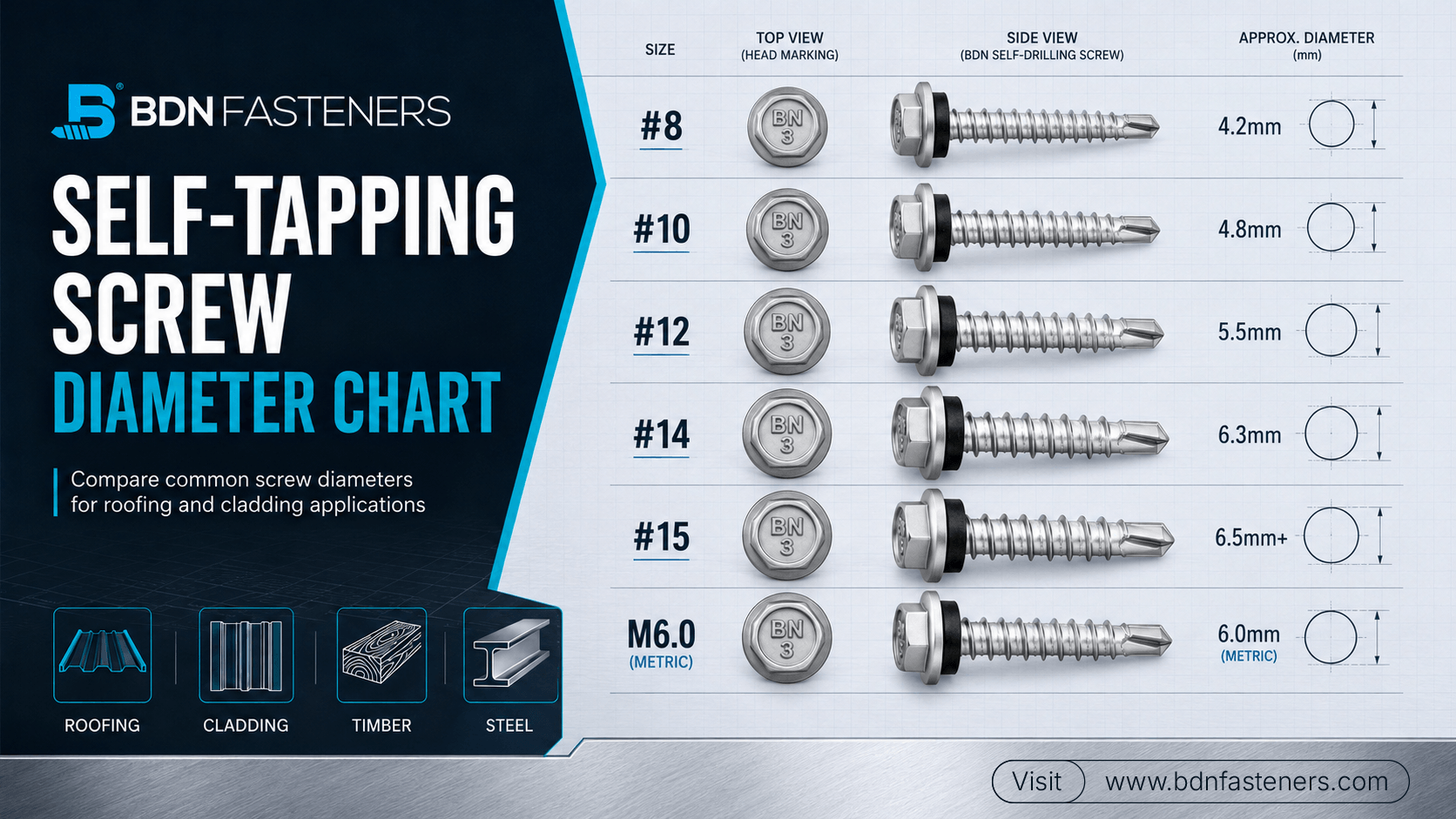
The table below gives common construction screw gauge references and approximate metric diameters. These figures are useful for quick comparison, but final selection should always follow the technical data sheet or catalogue.
| Screw Gauge | Approx. Major Diameter | Common Construction Use |
| #8 | Approx. 4.2mm | Light sheet metal, light fixtures, accessories |
| #10 | Approx. 4.8mm | Cladding, valley fixing, light metal-to-metal or metal-to-timber |
| #12 | Approx. 5.5mm | Roofing, crest fixing, purlins, timber battens, stronger pull-out |
| #14 | Approx. 6.3mm | Heavier roofing, thicker sheets, stronger structural fastening |
| #15 | Approx. 6.5mm+ depending on design | Stitching or specialty roofing applications |
| M6.0 | 6.0mm metric | Framing and structural light steel connections |
The larger the screw diameter, the greater the potential bearing area and thread engagement. However, larger is not always better. The correct diameter depends on the substrate. Thin steel may not support an oversized thread without stripping. Timber requires enough thread depth and penetration. Roofing applications must also consider washer compression, roof profile height, crest or valley location, and corrosion exposure.
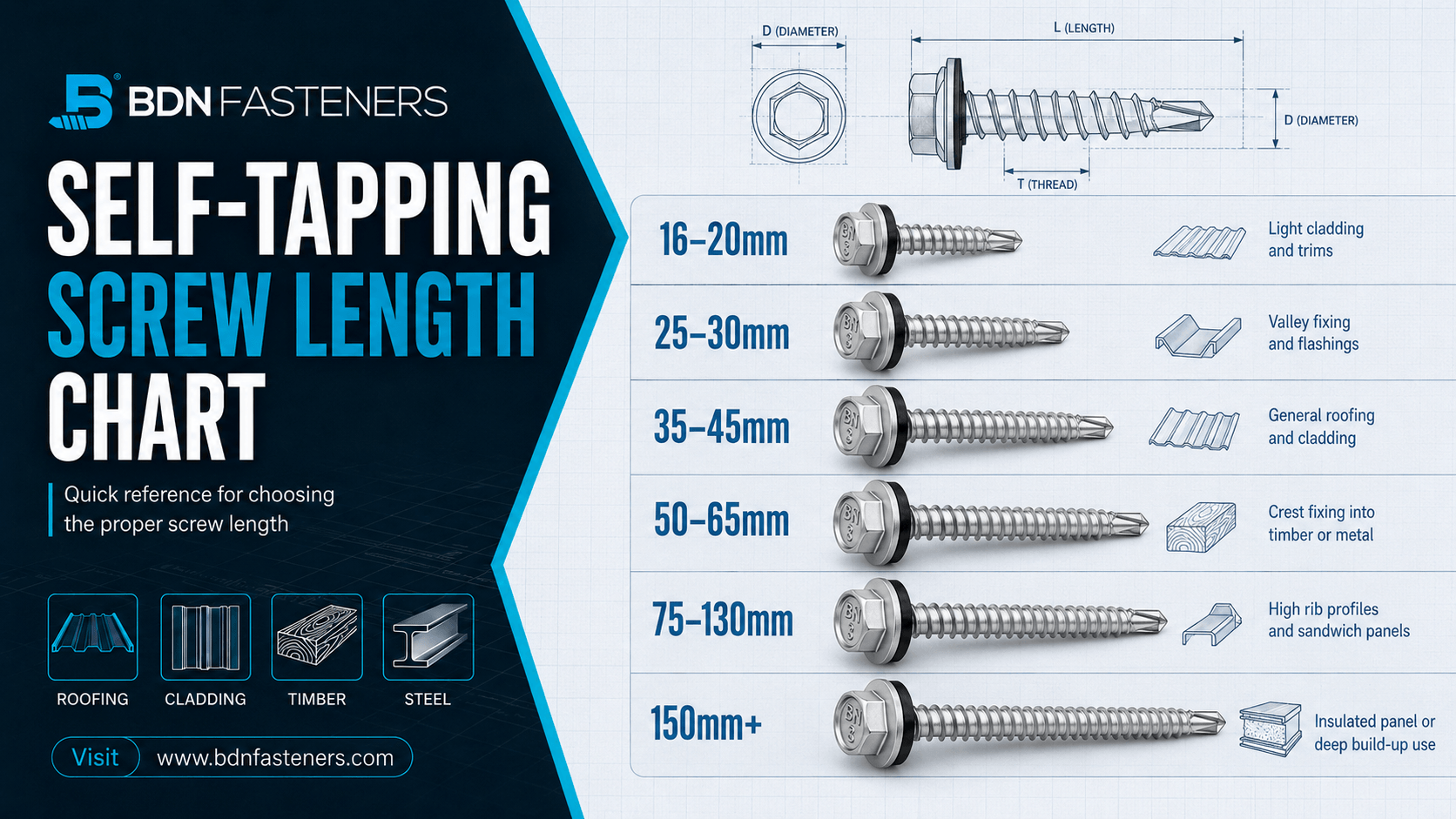
Self-Tapping Screw Length Chart
Length selection depends on the total build-up: sheet thickness, profile height, washer thickness, insulation layer, batten or purlin depth, and required embedment into the substrate.
| Screw Length | Common Use Case | Typical Selection Logic |
| 16mm-20mm | Light cladding, stitching, panel lap fixing | Used where only thin sheet-to-sheet or shallow fixing is required |
| 25mm-30mm | Valley fixing, light roofing, wall cladding | Suitable for thinner roof or wall sheets where profile height is low |
| 35mm-45mm | General roofing and cladding | Allows more engagement where sheet build-up is moderate |
| 50mm-65mm | Crest fixing into timber or metal | Common where the screw must pass through the crest of a roofing profile |
| 75mm-130mm | High rib profiles, insulation, sandwich panels | Used where a longer shank is required to pass through profile height or insulation |
| 150mm+ | Specialty insulated panels or deep build-ups | Selected according to panel thickness and engineering requirements |
A correct screw length should allow the point and thread to fully engage the substrate without over-driving. For timber, the screw must penetrate deeply enough to achieve holding power. For steel, the screw must form or cut sufficient thread engagement without stripping. For roofing, the washer must seal properly without being crushed.
Size Chart for Type 17 Timber Self-Tapping Screws
Type 17 screws are sharp-pointed fasteners designed to cut into timber. They are widely used for fixing metal roofing sheets to timber battens or wooden substrates. The Type 17 point helps reduce splitting, improves starting performance, and allows faster penetration into timber compared with a plain sharp point.
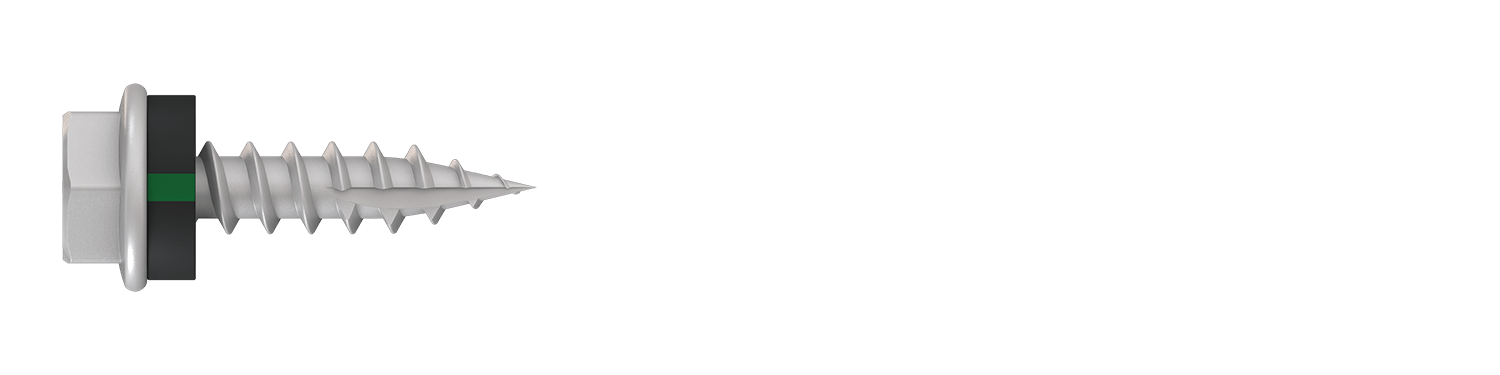
Type 17 Valley Fixing Screws
Valley fixing screws are shorter because they are driven into the lower part of the roofing profile. They are commonly used where the fixing is specified at the valley or pan of the sheet.
| Size | Common Application | Notes |
| 10-12 x 20mm | Light valley fixing into timber | Short length for low build-up applications |
| 10-12 x 25mm | Valley fixing into timber | Provides extra embedment over 20mm |
| 12-11 x 25mm | Stronger valley fixing | Larger diameter category for improved holding |
| 12-11 x 30mm | Valley fixing where extra penetration is required | Useful for slightly thicker sheet or deeper engagement |
For timber valley fixing, the key requirement is adequate penetration into the timber substrate. A common rule is that the screw must engage enough timber to resist pull-out, wind uplift, and vibration. Under-driving may leave the washer loose. Over-driving may deform the washer, damage coatings, or reduce sealing performance.
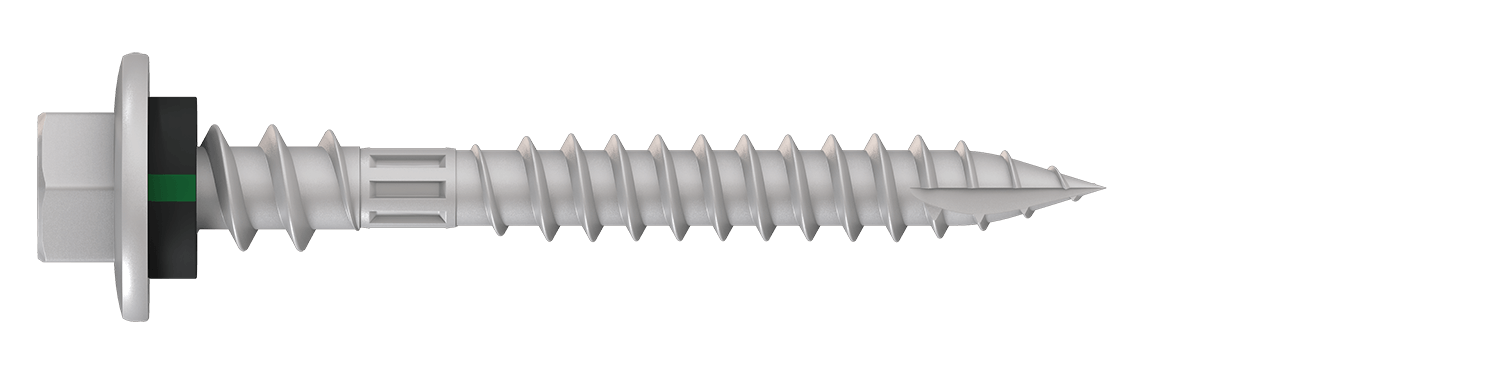
Type 17 Crest Fixing Screws
Crest fixing screws are longer because they pass through the raised crest of the roof sheet before entering the substrate. They are commonly used in metal roofing because water naturally flows toward the valleys. Fixing on the crest can reduce the risk of water pooling around the washer.
| Size | Common Application | Notes |
| 12-11 x 50mm | Crest fixing into timber | Suitable for lower to medium roof profiles |
| 12-11 x 55mm | Crest fixing into timber | Adds extra allowance for profile height |
| 12-11 x 65mm | Crest fixing into timber | Used where additional length is required |
Crest fixing screws may include double thread and a Scratshank-style section. The larger upper thread can improve sheet clamping and pull-out performance, while the shank feature helps clear swarf and protect the sealing washer.
Size Chart for Self-Tapping and Self-Drilling Metal Roofing Screws
In roofing and cladding, self-tapping and self-drilling screws are often grouped together because both are used to fasten sheet metal to timber or metal. The main difference is that a self-drilling screw has a drill point that creates its own hole, while a self-tapping screw forms or cuts its thread after entering the material.
| Size | Application | Typical Use |
| 10-16 x 16mm | Cladding to metal | Short valley fixing or light gauge cladding |
| 10-16 x 19mm | Cladding or stitching | Light sheet-to-sheet or sheet-to-light-steel fixing |
| 10-16 x 25mm | Cladding to metal | Extra length for stronger engagement |
| 12-14 x 20mm | Cladding to steel | General wall or roof cladding |
| 12-14 x 25mm | Cladding to steel | Increased engagement or thicker sheet build-up |
| 12-14 x 30mm | Cladding to steel | Deeper fixing requirement |
| 12-14 x 35mm | Cladding to steel | Longer valley or wall fixing |
| 12-14 x 45mm | Roof sheeting to metal | Full-thread crest or roofing fixing |
| 12-14 x 50mm-130mm | Roof sheeting or insulated panels | Longer build-ups, profile height, or insulation |
| 12-24 x 32mm-50mm | Thick steel fixing | Used with heavier drill-point designs |
The screw drill point must match the steel thickness. A light-duty drill point may be fast in thin metal but unsuitable for thick steel. A No.5 drill point, for example, is used for thicker steel applications and is designed to drill through heavier substrates.
Choosing the Right Screw for Roofing Applications
Roofing screws must do more than hold the sheet down. They must also resist wind uplift, weather exposure, thermal movement, and washer degradation. For metal roofing, the most important selection factors are:
- Roof profile height – high-rib profiles need longer screws, especially for crest fixing.
- Fixing position – crest fixing generally requires longer screws than valley fixing.
- Substrate – timber battens require Type 17 sharp point screws. Steel purlins require self-drilling points suitable for the steel thickness.
- Washer type – roofing screws commonly use EPDM or weatherproof sealing washers. The washer must compress enough to seal but not so much that it bulges, splits, or loses elasticity.
- Corrosion environment – coastal, industrial, humid, or chemically exposed environments require stronger coating systems.
Pull-out strength – stronger wind zones, exposed roofs, and large sheet spans may require larger diameter screws, deeper embedment, or specialty thread design.
Choosing the Right Screw for Timber Applications
For timber, the most common choice is a Type 17 self-tapping screw. The sharp point cuts into the timber and helps the screw start quickly without a pre-drilled pilot hole in many applications. For metal roof sheet to timber batten fixing, the screw must pass through the sheet and penetrate the timber deeply enough to achieve holding strength.
A shorter valley fixing screw may be suitable for low-profile sheet fixing, while a longer crest fixing screw is required for raised roofing profiles. For example, a 12-11 x 50mm, 55mm, or 65mm screw may be selected depending on the profile height and the timber penetration requirement.
When selecting timber screws, avoid focusing only on length. Check the point type, upper thread design, washer, coating, and driver size. A screw that is long enough but poorly matched to the roof profile may still fail to seal or hold correctly.
Choosing the Right Screw for Steel Applications
Steel fastening depends heavily on substrate thickness. A screw for thin steel cladding may not drill thick steel. A screw for thick steel may be slower or unnecessarily aggressive in light-gauge applications.
For light cladding, common sizes include 10-16 x 16mm, 10-16 x 19mm, and 10-16 x 25mm. For heavier cladding and general roofing to steel, 12-14 sizes are common. For thick steel fixing, 12-24 screws with a No.5 drill point may be used where the substrate requires a stronger drilling capacity.
Thread engagement is critical. If the screw strips the steel, the connection loses strength. If the drill point is too short for the total material thickness, the threads may contact the steel before drilling is complete, causing breakage or poor installation.
Head Style and Washer Size
The screw size chart should always be read together with head style and washer selection. A hex washer flange head is common for roofing because it provides good driving stability and broad clamping. Wafer heads are used where a low-profile finish is required, such as concealed fixing. Button heads are suitable for certain clip-fix applications. Countersunk or ribbed heads are used where flush seating is required.
For roofing, the washer is a major part of the fixing system. A correctly selected washer spreads pressure, seals the penetration, and helps protect the roof sheet. However, washers can be damaged by swarf, over-driving, UV exposure, incompatible materials, or poor coating selection. Screws with swarf-clearing features can help protect washer performance during installation.
Practical Self-Tapping Screw Size Selection Table
| Application | Recommended Size Range | Preferred Point or Feature | Key Selection Factor |
| Metal roof sheet to timber, valley fixing | 10-12 x 20mm to 12-11 x 30mm | Type 17 sharp point | Timber penetration and washer seal |
| Metal roof sheet to timber, crest fixing | 12-11 x 50mm to 12-11 x 65mm | Type 17, double thread, Scratshank | Roof profile height and pull-out strength |
| Cladding to light steel | 10-16 x 16mm to 10-16 x 25mm | Self-drilling or reduced point | Steel thickness and cladding build-up |
| Cladding to medium steel | 12-14 x 20mm to 12-14 x 35mm | Self-drilling point | Purlin thickness and thread engagement |
| Roof sheeting to steel | 12-14 x 45mm to 12-14 x 90mm | Self-drilling, full or double thread | Profile height and substrate thickness |
| Thick steel fixing | 12-24 x 32mm to 12-24 x 50mm | No.5 drill point | Drilling capacity and steel thickness |
| Truss or plate connection | 12-14 x 20mm or metric framing sizes | Trident or structural drill point | Pull-out strength and connection design |
| Concealed fixing | 10-24 x 16mm to 10-24 x 22mm | Wafer head | Low-profile finish and steel thickness |
Common Mistakes When Reading a Self-Tapping Screw Size Chart
- Choosing only by length – length is important, but it is only one part of the specification. Diameter, thread, point, head, washer, and coating must also match the application.
- Using valley screws for crest fixing – valley screws are usually too short for crest fixing. The screw may not penetrate enough substrate, reducing holding power.
- Using timber screws in steel purlins – Type 17 screws are designed for timber. Steel purlins require self-drilling or self-tapping screws suited to steel thickness.
- Ignoring coating requirements – a correct screw size with the wrong coating can still fail prematurely in corrosive environments.
- Over-driving the washer – a crushed washer may look tight at installation but can leak later. Proper torque control is essential.
Ignoring drill-point capacity – for steel applications, drill point capacity must match the total thickness being drilled.
FAQ: Self-Tapping Screw Size Chart
- What is the most common self-tapping screw size for roofing?
Common roofing sizes include 10-12, 12-11, 10-16, and 12-14, depending on whether the screw is fixing into timber, light steel, or thicker steel. For timber crest fixing, 12-11 x 50mm to 65mm is common. For cladding to steel, 10-16 x 16mm to 25mm and 12-14 x 20mm to 35mm are common. - What does 10-16 x 25mm mean?
It usually means a #10 gauge screw with a 16-thread designation and a 25mm length. This type of size is common in cladding and light steel applications. - What does 12-11 x 65mm mean?
It usually means a #12 gauge screw with an 11-thread designation and a 65mm length. This type of size is commonly used for longer timber roofing applications such as crest fixing. - Are self-tapping screws and self-drilling screws the same?
Not exactly. Self-tapping screws create their own thread as they enter the material. Self-drilling screws also drill their own hole with a drill point. Many roofing and construction screws combine drilling, tapping, and fastening in one operation. - How do I choose the correct screw length?
Add the roof sheet or panel thickness, profile height, washer thickness, insulation or spacer thickness, and required substrate penetration. Choose a screw long enough to fully engage the substrate without over-penetrating unnecessarily. - What screw should be used for timber battens?
For timber battens, Type 17 sharp point screws are commonly used because they are designed to penetrate timber efficiently. The correct size depends on whether the fixing is through the crest or valley of the sheet. - What screw should be used for steel purlins?
For steel purlins, choose a self-drilling screw with a drill point suited to the steel thickness. Light steel may use 10-16 or 12-14 screws, while thicker steel may require 12-24 screws with a No.5 drill point.
Conclusion
A self-tapping screw size chart helps builders and contractors make faster, more accurate fastening decisions. However, the chart should never be read in isolation. The best screw is not simply the longest or largest screw. It is the screw that matches the substrate, roofing profile, fixing position, thread engagement, point design, washer system, coating requirement, and installation method.
For timber roofing, Type 17 screws in valley and crest fixing lengths are essential. For steel cladding and roofing, 10-16, 12-14, and 12-24 self-drilling screw sizes cover a wide range of light to heavy-duty applications. For professional construction, the safest approach is to cross-check the size chart with manufacturer technical data, project specifications, and local standards before installation.
The right self-tapping screw improves installation speed, holding strength, weather resistance, and long-term project reliability. In roofing, cladding, truss, and steel-to-timber applications, correct sizing is not just a purchasing detail. It is a core part of building performance.
Source Notes
- BDN Fasteners India catalogue page – product catalogue downloads and manufacturer overview: https://bdnfasteners.in/catalogue/
- BDN Fasteners India self-tapping screws page – TIMBER-Tite and TRUSS-Tite application details: https://bdnfasteners.in/roofing-screws/self-tapping-screws/
- Broaden / TW Polycarbonate TIMBER-Tite crest fixing fasteners – size examples and product specifications: https://www.twpolycarbonate.com/product/timber-tite-crest-fixing-fasteners/
- Google Search Central – guidance on creating helpful, reliable, people-first content: https://developers.google.com/search/docs/fundamentals/creating-helpful-content